Thursday, 26 December 2024

2024 IN REVIEW

It’s that time of year again, when we decide to look back at what we’ve done over the past twelve months. Frequently it’s a shock (for me, anyway) – sometimes in a good way, sometimes bad. This year’s a good one, since I appear to have done far more than I thought I had (an aspect of that good ol’ imposter syndrome, I suspect).

I had a Sherlock Holmes story published in the The MX Book of New Sherlock Holmes Stories Part XLIV: 2024 Annual 1889-1897 (that’s one away from XL5, for readers of a certain age): “Hollingbourne Grange”. Considering I once thought how nice it would be to write a Sherlock Holmes piece, somehow that had become several. I’m not complaining. I have one more in the pipeline, and I think that’ll be it. I’ve done everything I wanted with the character (and more!) so time to quit while I’m ahead (although I think Conan Doyle had thoughts along similar lines).


Peripherally connected was “The Return of Madame Sarah” in Sherlock & Friends: Eldritch Investigations edited by Lyndon Perry for Tule Fog Press, an anthology pitting investigators from the Holmes era against Eldritch horrors of a Mythos nature. I went with L. T. Meade (Elizabeth Thomasina Meade Smith) and Robert Eustace’s Madame Sara and her nemesis police surgeon Eric Vandeleur (as narrated by his assistant Dixon Druce) versus Nyarlathotep (or Nyar-lat-hotep, as I had it).

Also from Tule Fog, in their Swords & Heroes e-magazine, was the short story “Two Swords Waiting”, a heroic fantasy tale of twin sisters Brindglais and Brandguin and a couple of magic swords in what I have come to call my A World of Gods and Monsters series (quite likely a book in the making). The sequel – “Sisters of the Swords” – will see publication in the future.

From Sarob Press came The Ghosts & Scholars Book of Landscape Figures, edited by Rosemary Pardoe, which reprinted “All I Ever See” in a lovely, limited edition hardback. I shared the ToC with old friends David Sutton and John Howard along with many other notable authors and it was quite a privilege to be published in such a prestigious volume.


Then there was Phantasmagoria magazine #24, and the second part of my swords and dinosaurs serialised novel (presently of no fixed title), “Beyond the Ghost Caves”. We meet the remaining two protagonists, witness more cross-time oddness, and know that soon all of the characters’ disparate paths will cross. Issue #25 published an interview of yours truly, conducted by Allison Weir and Sarah Graven Weir in what was little more than a broom cupboard at Cherry Red’s in Birmingham at the Alchemy Press 25th anniversary get-together (which also celebrated certain significant birthdays for some attendees, and the 50th anniversary of my first published short story – “Designs of the Wizard” – in the BFS magazine Dark Horizons, for which I published a very limited edition chapbook of the story with cover artwork by Jim Pitts; no one at the place was allowed to leave until they took one).


I also turned up on Lee Benson’s Sunday lunchtime radio and streaming show – Listen with Lee on Black Country Xtra – making very little sense I suspect, even for a Sunday.

And as if that wasn’t enough, alongside Alchemy Press Supremo Peter Coleborn I co-edited an anthology of strange fiction for PS Publishing: Shadowplays. With fiction from Stephen Volk, Ray Bradbury, Rosanne Rabinowitz, Nancy Kilpatrick, Paul Kane, Robert Bagnall, Colleen Anderson & Tom Johnstone, Gary McMahon, Steve Rasnic Tem, Gail-Nina Anderson, Tim Jeffreys, Marion Pitman, Bret McCormick, KC Grifant, Garry Kilworth, John Linwood Grant, Wendy Purcell, Joanne Anderton and Reggie Oliver, it’s a book of which I feel justifiably proud. A signed, limited edition hardback will be available in 2025.

The major event of 2024 however was me dipping my toes into self (or independent) publishing. The first was a slim volume, Drawing Down Leviathan, collecting all three stories featuring (to date, anyway), the submarine USS Oswin: “Cradle of the Deep”, “Echoes of Days Passed”, and the previously unpublished title novella. My plan was to make all the mistakes and learn from the experience before launching into a novel, Hail the New Age – a fantasy thriller in the sub-genre spies and sorcery (which I invented, maybe, with any luck). Reviews for both books follow (with permission) so I’ll not say another word about them.

***

Lyndon Perry, Tule Fog Press:

Mike Chinn’s 3 novelettes collected in the volume Drawing Down Leviathan is simply fun, wholesome, pulpy adventure. The action takes place on a new experimental US submarine set in the late 1930s at the ramp-up to WW2. These tales are high sea battle romps with enough navy lingo to lend credibility and verisimilitude but not so much as to get in the way of the story.

First two tales (“Cradle of the Deep” and “Echoes of Days Passed”) involve a bit of sea monster mystery – man vs supernatural beast trope. Entertaining, nothing ground-breaking, but they definitely hit the right notes of cinematic nostalgia – think of the childhood excitement of shows like Voyage to the Bottom of the Sea or 20,000 Leagues Under the Sea.

The opening story features the author’s pulp-styled action hero protagonist, Damian Paladin and his enigmatic sidekick, Leigh Oswin; and it ends with a sly bit of nomenclature humour. I was hoping for a return of Paladin in the second story, but the tension and mystery weren’t lacking even though the focus switched to the submarine captain and his crew. (BTW, Paladin appears in a couple different collections of the author’s stories, namely, The Paladin Mandates and Walkers in Shadow. Worth looking up if you enjoyed “Cradle of the Deep”.)

In the final story “Drawing Down Leviathan”, we have an encounter with a dangerous female ‘bad guy’ – the Captain-Admiral of a floating fortress. I liked the steampunk feel to this story, my mind going to Jules Vern’s famous antagonist, Captain Nemo. Action-packed and satisfying. I’d like to read more stories where our brave submarine captain and crew go up against this evil mastermind.

If you’re on the lookout for some quick adventure (about 100 or so pages) that brings back the pulpy action heroics from your childhood, this short collection is just the thing.


Trevor Kennedy, Phantasmagoria magazine:

Sea monsters and Nazis! Just a couple of the perils faced by the crew of the submarine, the USS Oswin, named after pulp hero Leigh Oswin, who, along with her dashing pilot partner Damian Paladin, appear in the opening story of author Mike Chinn’s new trilogy of nautical fantasy adventure tales. It’s 1936 and Chinn’s recurring characters serve to help introduce the reader to the crew of the submarine cruiser, helmed by Captain Dave Bannon and Commander Brad Munrow.

In the first story, “Cradle of the Deep”, the new team assigned to the prototype sea craft are assisted by Damy and Leigh and together they soon encounter a strange sea beast. “Echoes of Days Passed” sees the Oswin boarded by navy top brass just as they face off against another terror of the deep, and in the final title story they come up against a nefarious world conspiracy involving Nazis and a huge, fully-armed ship. Gun battles of a seaborne nature and within the air ensue.
 
Drawing Down Leviathan is some old-school pulpy enjoyment and exceptionally well researched at the same time – Chinn really does know his stuff in terms of naval and aviation terminology and technical details of the era, along with other relevant historical knowledge. This, of course, lends an air of authenticity and believability to proceedings.

Plainly inspired by Irwin Allen’s Voyage to the Bottom of the Sea, this is strongly recommended for those of us who are into these types of underwater adventures from a seemingly bygone age, something that the author himself clearly still has a strong enthusiasm for, this being made quite clear inside the pages of Drawing Down Leviathan.


Chris Morgan, Birmingham Science Fiction Group newsletter:

Ninety years ago Agatha Christie’s Murder on the Orient Express was published. Now Mike Chinn has written a great fantasy version of it. In a more-or-less 19th century world, where wizardry competes with science and technology, a railway track has been laid between Ramini’s two major ports, Scan Leroth and Scana Carsofi. The inaugural two-week train journey is about to begin. On board are the technological genius responsible for the project, Professor Alva, and a small number of invited guests. They are meant to be celebrating the technological innovation of the steam railway. But nothing is as it seems to be and at least one of the guests is secretly a wizard (they are now out of power and beyond the law) determined to make the journey a total failure.

The Hercule Poirot figure here, who must work out who is who and prevent the failure of the trip, is Wilonek Scilli (dare I say that all the characters have been given silly names?) an unprepossessing youngish man. He has survived years of training at the wizards’ seminary without becoming a wizard or in any way favouring them. He’s also rather like a US crime fiction investigator, in that he’s often beaten up and bleeding. His weakness is this: his wizardry training has left him needing a liquid drug, chavet, every day or two, or else he suffers awful withdrawal symptoms.

All the power of wizardry on this world emanates from crystals of abaston, a rare mineral of which wizards control the supply. An important part of their training is the handling of abaston.

Aboard the train are a marvellous group of eccentrics. There’s the artificially created heteromorph, Batrix, currently in female shape, who is a military lieutenant-commander (in charge of the venture) with whom Scilli has numerous encounters, trying to convince her that they’re on the same side. Others include Thryme (Alva’s mentor), Senator Nachollni, Dr Tork (a medical man) and Scendik Boz, a fiction writer from a nearby country. Also present is Major Rengalet, a former military hero and current alcoholic, who commands a group of about a dozen Sharpshooter militia, who seem to be non-speaking characters, only there to be killed. This being 19th century-ish, the Sharpshooters all have muskets, while most of the others carry repeating pistols (another Alva invention) which are sometimes reluctant to work properly.

The journey is beset with a multitude of problems. There are appearances by various swamp creatures and other monsters. The main train driver (or pilot, as Chinn would have it) is Sanej, a planted detective and a great friend of Scilli. When he is killed, Scilli is accused of the crime. The steam-driven locomotive is revealed to be abaston-powered. There are crashes and uncouplings of carriages as characters and their pasts are revealed. Every scene contains tension, excitement and surprise.

Just when you think the novel is ending, along comes an advert for a second exciting adventure starring Scilli and Batrix. Hail the New Age is privately published with a wonderful cover illustration.


Benjamin Kurt Unsworth, British Fantasy Society Online:

Given the popularity of the murder-mystery genre, it is always nice to see a new spin on it; one of the latest of these comes in the form of Mike Chinn’s Hail the New Age. Set in a world where the fantastical and technological have been clashing in civil war, the Ramini Republic has emerged, most of the magical Chrysomancers have been weakened, and distrust prevails. But the herald of the new technological dawn is the Novandik, a train whose inaugural coast-to-coast journey is beset by spanners in the works, of which a wizard determined to end the Novandik’s journey and many a backstabbing, metaphorical or otherwise are just the start.

The Ramini Republic manifests like a serrated version of a Studio Ghibli universe, vibrant and with the steampunkish mix of societies coming across smoothly and without delay. However, whereas Studio Ghibli leans more into the world of dragons, capes, and breathtaking vistas, Chinn’s universe is a drastic step in the other direction. The protagonist Wilonek Scilli, a not-wizard but with wizard training and an addiction to a drug called “chavet”, finds himself being beaten up at every turn as he tries to stop the Novandik being sabotaged. Less the Hercule Poirot figure, his role as detective feels more an involuntary manoeuvre, since the whole affair is styled less like Agatha Christie’s Murder on the Orient Express and more Eugenio Martin’s Horror Express – you can picture Telly Savalas playing many of the grumpy, affronted characters in a film adaptation.

Although Chinn’s prose is attuned more to action than description, the fantasy realm bleeds off the page in a no-holds-barred sort of way, and for readers who naturally go towards the crime or horror sections of the bookstore, it’s a nice segue into a fantasy universe. And yet for all its vibrancy, there’s a deathly sense of chill running through everything; the characters opposite Scilli all possess the kind of internecine causticity you’d expect from a disgruntled werewolf, and lieutenant-commander Batrix aboard the Novandik embodies that. Although Batrix functions as quite a nice metaphor for non-binary or gender fluid people, being a heteromorph who flicks between genders on a semi-regular basis, they’re also impossibly distrusting, and you can’t help except imagine their many speeches prefaced by a scowl and an angry hiss.

As a murder mystery though, it does keep you on your toes, and the action sequences, some of which do involve fantastical beasts, never detract from that even though they’re the overriding aspect. Not to say some of the surprises you can’t see coming, but there are also enough there which feel fresh and distinctive to keep you turning the pages, and the fantasy elements are never used as a Deus ex machina, rather a tool to enhance the tension and make Chinn’s prose that little bit more vivid and unexpected.

Ultimately, it leaves each genre time to stand on their own and make its mark; however, as a mix of the two, its smorgasbord of gritty fantasia achieves something greater, both breathtaking and savage with to-the-point prose. For what seems like a very unassuming novel, the almost romantic sense of bitterness is very much at the fore, and as you turn the pages – because, don’t worry, you will feel compelled to do so – its crisp sense of humanity, or perhaps inhumanity, knows how to beat you down. Reading this is a fabulous way to spend a few hours.

***

I’ll just leave you with a taster for 2025. Proving I learned nothing from the above experience I plan to publish two more books. Warriors of the Boundless, more heroic fantasy which I am proud to say will feature artwork by Argentinian artist Enrique Alcatena, who drew some of my fantasy scripts for DC Thomson’s Starblazer digest comic, and an introduction by another old friend, Adrian Cole. Then there will be a sequel to Hail, entitled Citadel of the Moon and featuring Batrix and Scilli, once again rooting out enemies of the Ramini Republic.


Thursday, 8 September 2022

SWORDS 'N' STUFF

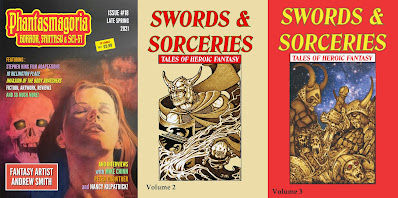
I’ve recently gotten back into writing sword and sorcery fiction again. Don’t know why (although by a strange coincidence, S&S does seem to be getting popular again, so maybe, for once, I’m tuned into the zeitgeist). I dug out some old stuff and gave it a good polish (or major re-writes, to be fair) and, miracle of miracles, actually had some of it published: in two of Parallel Universe’s Swords & Sorceries anthologies, and an edition of Phantasmagoria. Naturally, spurred on by this, I just had to have a crack at some new stuff.

The story published in issue 18 of Phantasmagoria in 2021 – “Face of Heaven, Eyes of Hell” – was set in a corner of my own multiverse (known variously as the Internection, the Boundless, the Infinite Tiers) where immortals have finally tired of their immortality and descended to the earthly plane in order to fight themselves into extinction, causing inevitable mayhem among humans as they go. They’d call it collateral damage these days. At some point I even jotted down a few notes (a grandiose term for the odd sentence, or even just a word or two) for more tales set in the same milieu, building up to a grand finale (with hints of The Magnificent Seven, or more appropriately, The Seven Samurai).

Recently I needed to submit something to a writers’ group I’m involved with and, firmly believing that no one should suffer alone, rattled off a second tale set in this universe (now labouring under the trite and – I hope – temporary title of ‘the God War’). However, I couldn’t find the notes I’d originally set down (imagining I’d deleted the file, either by accident or due to a lack of enthusiasm) so I used what was lodged in my memory (always a mistake).

Needless to say, when the hurley-burley was done, I found the original notes, stuck in a folder marked ‘Archive’. I had of course misremembered quite convincingly, with what I’d written actually being a mash-up of two separate ideas. Never mind: I now have half a dozen separate notes that I can fill out into proper plots at some point (one of which is a cheeky reworking of Poe’s “The Masque of the Red Death”, but with a red sword) and what I think is a more apt title for the second story.

It does go to show, though, never throw anything away. You never know when – or even how – it’ll come in handy.


Monday, 3 January 2022

THAT WAS 2021, THAT WAS

As 2022 kicks into high gear, I thought it might be about time to look back at what I’ve published in the last twelve months (and maybe a hint of what’s to come).

The year started with the delayed first issue of the relaunched Startling Stories from Wildside Press, and edited by Douglas Draa. The lead story was my “Cradle of the Deep” – ostensibly a Damian Paladin story it was also what they call in TV land a backdoor pilot. Leigh Oswin and Damy investigate something lurking off the US Atlantic coast on board the new, 400-foot long experimental submarine cruiser the SC-1. By story’s end the boat had been officially named the USS Oswin, much to Damy’s disgust (I think he was expecting it to be USS Paladin). Sub and crew resurfaced later in the year in The Alchemy Press Book of Horrors: A Miscellany of Monsters in “Echoes of Days Passed”, a tale deliberately constructed to mimic its Voyage to the Bottom of the Sea TV series inspiration, with something big in the North Atlantic sinking a Royal Navy secret testbed and eating its crew, before the Oswin gets involved due to a somewhat obsessional admiral. Death and destruction inevitably follow.
There’s a third Oswin story in the works – “Drawing Down Leviathan” – about to be revised and polished, involving a worldwide, seaborne organisation with huge ships that make 1930s aircraft carriers look like pedal boats, and an aircraft inspired by a Bel Geddes design. And even though a couple of Nazis get a walk-on part, I think I’ve found my series’ main baddies.

Next up was Phantasmagoria #18. This not only had a previously unpublished sword & sorcery piece of mine – “Face of Heaven, Eyes of Hell” – but also included me being interviewed by Allison Weir. A double strike if ever there was one.
And by one of those minor coincidences, Parallel Universe Publications’ Swords & Sorceries volume 2 also published a fantasy story of mine almost simultaneously, “The Essence of Dust”, which was an old piece that consisted of the original plot and very little else, having been pretty much rewritten from the ground up. And like “Face of Heaven, Eyes of Hell” it took place in my own fictional multiverse (although I prefer the terms Internection, or the Boundless), so there were the most tenuous of links. There’s also a vague connection with some of the fantasy strips I wrote for DC Thomson’s Starblazer (and illustrated by Quique Alcatena) for those who care to look. A few months later, Swords & Sorceries volume 3 published “The Rains of Barofonn”, a follow on from “Essence of Dust”, once more an old piece that has been revised, polished and expanded slightly. The submission period for volume 4 starts on April 1st (I hope the date’s not significant) and I will be most definitely throwing my hat in the ring once more.

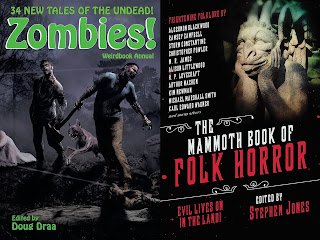
Another Wildside publication edited by Douglas Draa – the Weirdbook annual, Zombies – contained “O Mary Don’t You Mourn”, a story set in mid-1860s New Orleans and featuring a Native American protagonist I dreamed up decades ago for an absolutely dreadful Western novel I abandoned halfway through (you’re welcome). He felt like the perfect fit for the story, and I may well write more Mattan fiction in the future.
Another anthology that was delayed for a year, due to the Covid pandemic, was The Mammoth Book of Folk Horror, from Skyhorse and edited by Stephen Jones. My contribution, “All I Ever See” took its title from a line in Status Quo’s early hit, “Pictures of Matchstick Men” (repurposing song titles or lyrics is something I’ve been doing for a long, long time). Anyone who’s read the story will have made the connection, I hope.

Finally there’s Gruesome Grotesques: Carnival of Freaks from TK Pulp. Editor Trevor Kennedy asked me if I’d like to contribute and I said I’d do what I could. Inspiration came from a weekend break to the Lake District. I wasn’t entirely happy when the final documentation came and I found that not only would we be staying in Blackpool (a town I have no love for, embodying as it does – in my opinion – all the worst aspects of British seaside resorts) and a Britannia hotel. Luckily, the hotel had previously been the Blackpool Hilton and the shine hadn’t rubbed off yet (although Blackpool remained Blackpool). The first night, the sound of small feet running up and down the corridor outside our room – combined with what I later realised was a slight panic attack at breakfast the first day (the restaurant became increasingly full as we finished eating, and I’d grown unused to crowds) – were the seeds which quickly grew into “Hall of Dreams” and its dark themes of childhood abuse and repressed memory. The small fictional seaside town of Byemouth was no Blackpool, though.
And that’s it for 2021. I already have a list of stories to be written, polished or edited within the first quarter of 2022. Beyond that there’s nothing planned. No doubt something will turn up. It always does.

Happy New Year!

Saturday, 9 October 2021

ZOMBIE SEE, ZOMBIE DO


I don’t think it’s much of a secret that I’m no great fan of modern, so-called zombies in fiction (written or filmed). Mainly because most of the time the revenants aren’t really zombies – just the living dead (by means explained or not), and generally with a taste for living flesh (brains!!!!). I don’t think anyone has ever explained how they’re supposed to digest their meals, or moan, for that matter (they’re dead – they don’t breath!).

Yes, I get that Romero’s living dead are meant to be metaphors for capitalism, but most of the time the so-called zombies are clichĂ©d, shambling corpses that can still somehow overtake a running healthy person (The Walking Dead TV series really did miss the clue in the title).

However, I have been guilty of committing my own zombie stories a couple of times – although in my defence I do try and go for the traditional, raised from the dead and used as slaves motif (no doubt clumsily).

The first was “Zombie Dance” in the second Damian Paladin collection, Walkers In Shadow, and the second has just been published in the Weirdbook Annual: Zombies!. Entitled “O Mary Don’t You Mourn”, it’s a kind of Weird Western (if New Orleans can be said to be in the West), set around 1866/67, and featuring a Navajo character I came up with back in the late 1970s (when I started work on a truly appalling Western novel – long consigned to the trash-heap of history), and resurrected not-quite-dead that are a little closer to the zombie of voodoo legend – and inspired by that nasty fungus which turns insects into suicidal spore spreaders (not to mention imagery from William Hope Hodgson’s “The Voice in the Night”, which gave me the heebie-jeebies the first time I read it as a kid).

So, Weird Western zombie story. Another phrase I never thought I’d be applying to my fiction.


Friday, 10 September 2021

HORRORS OF ALL SORTS


There seems to be an unwritten rule with regard to writing. As time passes we edit and polish our work, submit it, and await the acceptance (hopefully) or rejection (sadly inevitable sometimes). Then we sit back and wait for publication.

And that’s where this rule comes in.

You can have stuff accepted over a period of a year or more, then – because of the vagaries of the publishing world (and the last couple of years has seen more vagaries than usual) – nothing for months. Then, like buses, everything turns up at once (which is fine in a way, because if people aren’t paying attention, it can look like you’re really prolific).

Which is a roundabout way of explaining why three short stories of mine are all seeing publication within a short time of each other, when they’ve been accepted over quite a range of time.

“All I Ever See” was accepted for The Mammoth Book of Folk Horror (Skyhorse, ed. Stephen Jones) back in 2020, but due to the pandemic the book was delayed for a year or so. The Kindle edition is now available, while the paperback will be out in October (and is available to pre-order here)

“Echoes of Days Passed” is the second salty tale of the submarine USS Oswin (first encountered in “Cradle of the Deep”, Startling Stories magazine 2021 [Wildside, ed. Douglas Draa]) and was accepted for The Alchemy Press Book of Horrors 3: A Miscellany of Monsters (The Alchemy Press, ed. Peter Coleborn & Jan Edwards) at the beginning of the year. This anthology is also due out in October, and is available to pre-order here.

“Hall of Dreams” is the baby of the bunch, conceived during a couple of nights’ stay in Blackpool in July. It will be seeing the light of day in Gruesome Grotesques Vol 6: Carnival of Freaks (TK Pulp, ed. Trevor Kennedy) in – you guessed it – October. You’d think there was some sort of festival celebrating spooks and other horrors at that time of year. Details for this as and when.

Three tales, acceptances spread over more than a twelve month period, being published within a few weeks of each other.

Odd business, this writing one.

Monday, 31 May 2021

RETURN OF THE SWORDS

Decades ago, back in the mists of time, my earliest attempts at writing revolved around what I later came to know as Sword & Sorcery (somewhat influenced initially by Edgar Rice Burroughs’ Mars series, and then Michael Moorcock’s Eternal Champion books). These primitive, immature scribblings morphed over time, and my earliest printed work was a very short story in the British Fantasy Society’s magazine, Dark Horizons #10 – “Designs of the Wizard” – in 1974. Two sequels followed – “Shadows of the Weaver” and “The Closing of the Days” – in Dark Horizons #12 and #14 respectively. All were bundled under the overarching title of “The Second Dragons”, and told an epic tale of human versus humanoid lizards in a post-apocalyptic desert Earth in well under 10,000 words. I returned to that particular world a couple more times – “Nightfall of a Dying World” (Dark Horizons 28, 1985) and “Fair Dues” (Dark Horizons 33, 1992) – when the mood struck, and may well do so again. I even wrote a novel, expanding on the original three stories; posterity will be relieved to know it no longer exists.

Now and then I’d dabble in other S&S tales [“The Pistol and the Sword” (Dark Horizons, 1979), “But the Stones Will Stand” (Fantasy Tales 10, 1982), “Sword of Light” (Victor Summer Special, 1987), and “Day of the Dark Men” (Fantasy Tales Vol.12 #6, 1991)], but over time I drifted away from that particular genre, for some reason. (Although I never entirely left: the jokey “Saving Prince Romero” was published in Unfit for Eden: Postscripts 26/27, in 2012).

Then, during 2020 – whether it was the unusually summery weather, or lockdown madness, who can say – I discovered a new enthusiasm for the form. I found time to dust off some of my unpublished S&S fiction and give it a good polishing (read: re-writing from the ground up) and I’m glad to say the exercise bore a little fruit. And so – by one of those typical coincidences which often plague the writer’s world – two pieces are appearing within a sort time of each other. “Face of Heaven, Eyes of Hell” has just been published in Phantasmagoria #18, while “The Essence of Dust” will shortly be released on an unsuspecting world in Swords & Sorceries Volume 2. And although there is little to connect either tale, they do take place in a shared universe (or should that be multiverse?).

I think it’s fair to say my S&S days are actually far from over.

Wednesday, 30 September 2020

PALADIN FLIES AGAIN

The new expanded edition of The Paladin Mandates is now out from Pro Se Press. In addition to "There'll Be a Hot Time in the Old Town Tonight" (which was only in the original Kindle edition), and "Deck the Halls" (published in the Occult Detective Monster Hunter anthology in 2015) there are two pieces unique to this new edition: "Have You Ever Seen a Dream Walking" and "Who's Afraid of the Big Bad Wolf".

Available in paperback and Kindle from Amazon US and Amazon UK

MORE HOLMES, GARDENS, AND SINGULAR WORMS

As I mentioned in my previous post, where I mused on some of my published Sherlockian pieces, I briefly mentioned my contributions to the long-running MX series of charity anthologies which are compiled for the restoration of Undershaw – the former home of Sir Arthur Conan Doyle and now a Stepping Stones school.

The first was “The Adventure of the Vanishing Man” which saw print in The MX Book of New Sherlock Holmes Stories Part V: Christmas Adventures in 2016. This has the honour of being the first canon Holmes story I ever wrote – since the Steampunk mashup Vallis Timoris certainly doesn’t count. Next came “The Adventure of the Haunted Room” in  The MX Book of New Sherlock Holmes Stories Part VII: Eliminate the Impossible, 1880-1891 the following year – investigations of possibly supernatural events which always have a rational explanation. A third – “The Adventure of the Singular Worm” – will debut in The MX Book of New Sherlock Holmes Stories Part XXIII: Some More Untold Cases, 1887-1894, the middle volume in a trilogy exploring the references Watson makes to some of Holmes’s undocumented cases over the years 1877 to 1903.

If you’d like to contribute to the Kickstarter for those books, the link’s here.

Tuesday, 4 August 2020

HOLMES IS WHERE THE HEART IS

Many years ago there was an independent bookshop in Birmingham by the name of Hudsons. During its declining years they introduced a bargain basement (no doubt to get rid of odd items of stock) where all sorts of goodies could be found. One time I came across a thin coffee table edition entitled THE SHERLOCK HOLMES SCRAPBOOK (dated 1973), edited by none other than Peter Haining, with a foreword by the one and only Peter Cushing.


It was a fascinating book, filled with articles, artwork, ads – in fact any kind of Sherlockian ephemera you can imagine. And it also mentioned new Holmes fiction had continued to be published after Conan Doyle’s death in 1930. That made me sad because I quite fancied the idea of writing a Holmes pastiche, but imagined the day for such things was gone (and I wouldn’t have known where to find a possible market at the time, anyway).

Fast forward to the 21st century, and that daydream finally came true. Not only did I end up writing that Holmes pastiche, I somehow managed a mash-up novel (VALLIS TIMORIS, Fringeworks, 2015), and a couple of shorts for David Marcum’s MX series of anthologies besides (“The Adventure of the Vanishing Man”, “The Adventure of the Haunted Room”) with a third – “The Adventure of the Singular Worm” – due out later in 2020. I even sold a Professor Moriarty story, “A Function of Probability” to Maxim Jakubowski’s THE MAMMOTH BOOK OF THE ADVENTURES OF PROFESSOR MORIARTY (Skyhorse, 2016). And did I stop there? Oh no. The latest to see print is in Belanger Press’s second volume of SHERLOCK HOLMES AND THE OCCULT DETECTIVES anthologies, edited by John Linwood Grant: “The Direction of Sunbeams”. Once again proving, it’s never too late.


And if I’d told that impressionable younger person as he bought that original Haining book, I wonder if he’d consider the idea “Incredible!” or “Elementary!”.

Thursday, 27 February 2020

IT'S PHANTASTIC


It’s all happening as 2020 kicks off. No sooner is Stephen Jones’ THE LOVECRAFT SQUAD: RISING published, but Trevor Kennedy’s PHANTASMAGORIA magazine is running a special (#2, if we’re counting) based around the book and Lovecraft. Among its many delights will be a brief life and times of one Damian Paladin – which means I get to share cover billing with some quite delightful people. Probably be the one and only time, so I’d best make the most of it (and since it’s alphabetical, I get to be on top).


PHANTASMAGORIA #14 will also include my short story “Chasing the Dragon” (originally published in Emby Press’s SUPERHERO MONSTER HUNTER: THE GOOD FIGHT), and elsewhere in that issue there may even be some of my artwork. So don’t say you haven’t been warned.

Both mags will be available later in March, with an official launch at StokerCon, Scarborough, in April.

Also launching at StokerCon is THE ALCHEMY PRESS BOOK OF HORRORS 2: STRANGE STORIES AND WEIRD TALES. Damian Paladin – along with Leigh Oswin, Andy Raven, and Leo Saint-Germain – crop up, the proverbial bad pennies, in “Digging in the Dirt”: an indirect sequel to the “Hastur La Vista, Baby” crossover with Adrian Cole’s Nick Nightmare published in THE LOVECRAFT SQUAD: RISING. Almost as if it was planned (and if you believe that, you give me way too much credit).


Saturday, 28 December 2019

2019: THE YEAR THAT WAS

This year’s annual round-up is pretty brief. One of those outwardly calm years when nothing much seems to be happening.

It started with a short SF piece seeing publication in KZINE #23 in January – “A World in Aspic”. Set in the Derry & Toms roof garden, in an alternate 1920s/30s, with the sort of clunking robots that graced the old movie serials I’d catch the odd episode of at the Jacey cinema in Birmingham during rare childhood Saturday afternoon visits.

I also worked on a couple of novellas I’d promised people in moments of weakness. One was for Fringeworks: a steampunk Sherlock Holmes sequel to my VALLIS TIMORIS mash-up; the second for Dion Winton-Polak’s TWISTED EARTH shared world. All that interspersed with editing a couple of novels for a friend.

During the latter half I teamed up once again with old mate Adrian Cole to co-write another Damian Paladin/Nick Nightmare team-up for Stephen Jones’ THE LOVECRAFT SQUAD: RISING. Entitled “Hastur La Vista, Baby”, we somehow kept things going over two separate timelines that eventually merged; and I took the chance to shake things up a little in the Paladin-Oswin universe.

Speaking of Paladin and Leigh, they continue to fight the good fight in “Digging in the Dirt” for THE ALCHEMY PRESS BOOK OF HORRORS 2 (out early 2020), and their decidedly VOYAGE TO THE BOTTOM OF THE SEA-inspired adventure “Cradle of the Deep” is due to appear imminently in STARTLING STORIES #1.


I also kept the Sherlock Holmes banner flying with the decidedly non-canon “The Direction of Sunbeams” for the self-explanatory SHERLOCK HOLMES AND THE OCCULT DETECTIVES anthology coming from Belanger Books.

And in late 2020 I’ll be making another appearance in a Stephen Jones edited anthology, THE MAMMOTH BOOK OF FOLK HORROR, with “All I Ever See”.

The year ended with one of those coincidences that crop up infrequently: two interview requests, each coming hard upon the other. One was for Trevor Kennedy’s PHANTASMAGORIA #13, the Christmas special, and the second for an article by Stephen Jewell on DC Thomson’s STARBLAZER digest comic of blessed memory, commissioned by the JUDGE DREDD MEGAZINE. Both issues emerged just in time for Christmas.


As for 2020 itself? Who can say. I continue to fly by the seat of my pants, with little to no planning – but at least I’m keeping boredom at bay. And life still, on occasion, surprises me.

And so may I take this opportunity to wish you all a Happy New Year, and continuing good fortune in these trying days. 

Monday, 12 August 2019

ALL I EVER SEE

Really happy to announce my short story "All I Ever See" has been accepted for Stephen Jones' forthcoming anthology The Mammoth Book of Folk Horror. And chuffed to find I'm also going to be sharing it with such luminaries as David A Sutton, Alison Littlewood, and Jan Edwards.
The title's a line from an old Status Quo single. That and the above image are all the clues you're going to get.

Saturday, 22 December 2018

2018 AND ALL THAT

As the year grinds inevitably towards its end we come, with equal inevitability, to the annual round-up and hopeful glances towards the future. Not a very long post, you’ll be glad to hear since 2018 has been fairly quiet with regard to publications.

In June I achieved a lifelong ambition, and had a Jerry Cornelius story published on the Further Adventures of Jerry Cornelius website. Titled "Pierrot in Bombazine" I had fun playing with steampunk tropes, among other things.

July saw a story of mine appear in PICKMAN’S GALLERY from Ulthar Press: an anthology of Lovecraftian fiction that took its cue from the original HPL story, “Pickman’s Model”. My own contribution, “Eigenspace X”, was an askance look at the modern art world, and what happens when sculpture meets multi-dimensional mathematics.

The Western I’d always wanted to have a go at was published by Pro Se Publications in August: REVENGE IS A COLD PISTOL. I was surprised (and delighted) to discover that not only were there paperback and Kindle editions, but also a hardback. To my mind, the publishers should have scrapped the paperback and just gone with hardback (while maybe reducing the price a little): the whole product looks so much sharper, the cover art more vibrant.

WEIRDBOOK #40 included my “And the Living Is Easy”: a short story which started life as a one-act play, believe it or not. Concerning two sun gods hiding away from a poisoned or dying sun, it probably works best as short fiction (a good man always knows his limitations).

And my final appearance of the year was in THE ALCHEMY PRESS BOOK OF HORRORS. Unable to resist diving back below the deep blue briny and mixing up a Kate Bush track with a Japanese monster, I came up with “Her Favourite Place”. 
* * *
And for 2019? It’s often difficult to be precise, because publishing is rarely an exact science, but I can say that Graeme Hurry’s KZINE #23 is out in January and includes a short SF story of mine: “A World in Aspic” (which you might describe as valvepunk, if we’re throwing labels around).

Damian Paladin will be returning in “Cradle of the Deep” in the first issue of the relaunched STARTLING STORIES (you guessed it: more underwater frolics), and a revised and expanded edition of THE PALADIN MANDATES (includes two previously unpublished adventures for Leigh Oswin and Paladin) should be heading your way. And elsewhere, if the stars are right, another team-up with Adrian Cole’s Nick Nightmare. Those two do get around.

Finally, there is another short novel ready to be unleashed on the unsuspecting world: involving an updated masked avenger which, no one will be surprised to hear, involves quite a lot of flying. And hand to hand fighting. And gunplay. Details as and when. 
* * *
And that’s it. Just remains for me to wish everyone a Happy and Prosperous 2019. Be good to each other.

Thursday, 18 October 2018

WHAT'S THAT WEIRD BOOK...?

Weirdbook has existed, in a variety of iterations, since the late 1960s, coming into its own in the mid-1970s. It was a quality small press magazine long before the term Small Press was coined, and I discovered it in the early 70s. I'd joined the British Fantasy Society and was rapidly becoming aware of a hitherto unknown world of authors, books and magazines. The society's annual convention, FantasyCon, gave these publications flesh and I gladly offered up all my hard-earned cash to get my hands on them.

Edited by W Paul Ganley, Weirdbook looked the business. It had covers by Stephen Fabian, poems by Robert E Howard and Joseph Payne Brennan, fiction by the likes of H Warner Munn, Brian Lumley, Eddy Bertin, Adrian Cole, Darrell Schweitzer and L Sprague de Camp. It was as professional as it was possible to be on a tiny budget. It never occurred to me - fledgling writer that I was - that one day I'd by published within its pages.
Unlike its contemporaries, Weirdbook has managed to survive – now published by Wildside Press and edited by Douglas Draa, with W Paul Ganley as consulting editor - looking to the developing styles of weird fiction of the 21st century whilst unashamedly celebrating its roots. Once again, Darrell Schweitzer and Adrian Cole are regulars, along with plenty of fresh blood.

And I've made it too. Issue 40. Check it out.

Friday, 10 August 2018

HAVE PEN WILL SCRIBBLE


I’m of that generation where Westerns were everywhere: films, TV, books. I just about remember watching Richard Boone as Paladin (now where’ve I heard that name before?) in Have Gun, Will Travel, along with Sugarfoot, Rawhide, Wagon Train, and in later years Alias Smith & Jones and The High Chaparral.
But I did lose interest in the movies sometime in the mid-1960s. Back then the BBC would show a Saturday Western every week and, to be honest, most were poor quality, assembly-line films lacking in originality, budget, or decent actors. I reached a point where I just couldn’t bring myself to watch another Western movie. That is, until I was at polytechnic.

I was far too young to see A Fistful of Dollars when it first came out; though I do remember the fuss caused by its amorality and perceived sadism. Several years later, though, I was a student at Lanchester Polytechnic. On Wednesday afternoons a film club ran in a lecture theatre; one film I watched was For a Few Dollars More. It was like a slap around the face. That same year High Plains Drifter was released and I watched it at a Coventry flea-pit on a double bill with Two Mules for Sister Sara. In no time I was a fan of both Clint Eastwood and Italian Westerns.
I never read many Western novels – although paperbacks by British authors such as Terry Harknett (under a variety of pseudonyms) and JT Edson were everywhere throughout the 1970s. I did peruse the odd novelisation (such as the first two “Dollar” films and A Fistful of Dynamite) and Glendon Swarthout’s The Shootist (the film adaptation of which is still my favourite John Wayne film). I was – and still am – mainly into Horror, Fantasy and Science Fiction, and writing same.

Then, towards the end of the 70s, I hit a period of enforced idleness. I don’t know how many of you remember the smallpox outbreak at Birmingham University’s Medical School, but my department was caught up in the tragedy. We were sent home for an open-ended period while part of the building was decontaminated. I grew bored rapidly and, for reasons I no longer remember, started writing a Western. It was pretty bad: the central character, Quarrel, was an obvious Man With No Name knock-off, everyone else an assembly of clichĂ©s. I abandoned it when I returned to work.
But the odd thing was, I’d enjoyed it – purple prose and stupid plot notwithstanding. And it had swiftly become clear that, unless you were writing a strictly historical one, Westerns were as much Fantasy as anything from the pen of Michael Moorcock, Fritz Leiber or Robert E Howard (who did write Westerns, of course). And Quarrel never went away: lurking in the depths of my head, biding his time. Eventually, his time came.

A couple of years back, Pro Se Publications accepted a Damian Paladin book, Walkers in Shadow,  for publication, and I found myself wondering if there was something else I could try out on them. A Western? I thought. Pro Se is a New Pulp publisher, and Westerns are one of the oldest forms of pulp fiction.

With a new look and a first name – Arieh – Quarrel came a-knockin’. Shamelessly borrowing the plot of Walpole’s The Castle of Otranto (well, adapting Samurai movies hadn’t done Sergio Leone or John Sturges any harm) and going for a slightly more Italian Western vibe, I pitched the idea at Tommy Hancock at Pro Se. “Write it,” he said. And thus was Revenge is a Cold Pistol born. I am now a published Western author – words I never thought I’d write.
Will Arieh Quarrel return? Well, I’m working on a storyline at the moment, and I’ll pitch it once it’s complete. Then we’ll see.

Tuesday, 10 April 2018

Review of RADIX OMNIUM MALUM


"Anyone who wants to spend time with the uncanny and horrific will find this volume contains gems"


Pauline Morgan has reviewed RADIX OMNIUM MALUM & OTHER INCURSIONS for both the SFCrowsnest website and the Birmingham SF Group's newsletter. With Pauline's permission, I happily repost the review.

Anyone who has heard of Mike Chinn will probably be familiar with either his steampunk versions of Sherlock Holmes or his Damian Paladin stories. Since the works of Sir Arthur Conan Doyle are now out of copyright, there have been a number of stories and novels (of varying degrees of competence) using this character. Mike Chinn’s rank in the higher echelons of the sub-genre but there is a danger of them being lost. Damian Paladin has, so far, two collections devoted to his exploits which are well worth hunting down. Mike, though, has written and had published a wide range of other stories, some of which are included in this new volume. From a man who keeps guinea pigs they are often surprisingly dark.

Devising ways to end the world, or at least human domination of it, is a favourite pastime of horror writers. ‘Radix Omnium Malus’ (loosely translates as ‘The Root of Evil’) is reminiscent of Brian Lumley’s ‘Fruiting Bodies’ but here the malicious growth has been magically invoked and is out of hand and is consuming everything. In ‘Blood of Eden’ instead of an indestructible plant it is Dracula threatening world domination using corporate means. ‘Cheechee’s Out’ is the start of an alien invasion, with Cthulhu-type creatures taking over men in high positions. Inevitably, there will be collateral damage.

Monsters of several varieties occur within a number of these stories. The trick is doing something new with them. In ‘Sons of the Dragon’ the road builders in Romania encounter vampire worms and ‘Considering the Dead’ relates the history of Cthulhu, but the biggest monsters are human. ‘Kittens’ begins as an urban myth, this time the story of kittens being dumped in a glass recycling bin and morphs into serial killer nastiness.  In ‘Only the Lonely’ the monster is a female sexual predator. Instead of being a warning for young girls it is the middle-aged man that needs to beware.

One of the causes of people believing they have had supernatural encounters is anxiety. ‘Two Weeks From Saturday’ is one of those stories that anyone who has been reluctantly included in an event will understand. For Cliff it is the impossibility of writing a decent story for the writers’ meeting run by his boss’s son that creates nightmares. Grief, too, is an emotion that can affect the mind. ‘The Streets Of Crazy Cities’ demonstrates an extreme reaction that Martyn has after the death of wife, child and several other people that he knows. It is a story that initially misleads and shows the skill of the author in its construction.

These and the others stories in this volume challenge the reader. They meld folklore and myth into, mostly, modern settings. There is one historical story there, ‘Suffer A Witch’ which demonstrates petty human jealousy and the danger of drawing conclusions. Like the characters it is unwise to assume that you have all the knowledge needed to understand the situation. In ‘The Pygmalion Conjuration’ both Dennis, who finds a conjuration to bring to life photographs of desirable women for sex, and Miss Grant, the librarian who pointed him towards the relevant book, find to their cost that they have missing information.

Folklore doesn’t have to have an ancient pedigree. The urban myth behind ‘The Owl That Calls’ has a more recent genesis, but even these may have some reality behind them as Tomas Ullerden discovers when expecting to debunk the sighting of a Mothman on Bodmin Moor. While many myths have their roots in a pagan or superstitious past, the coming of the steam age has imbued trains with a degree of mysticism, often involving death. Two train stories are included here. ‘Rescheduled’ sees Graeme having to go home to fetch the office keys and having distinct problems with trains, while in ‘The Mercy Seat’ Jim catches up with two friends from his youth. The memories revolve around the railway bridge by the station and the trains that run over it

Some of the stories in this volume need to be read more than once to find the subtleties in the story telling, but for anyone who wants to spend time with the uncanny and horrific they will find this volume contains gems.

Monday, 12 February 2018

THE ALCHEMY PRESS BOOK OF HORRORS Table of Contents

British Fantasy Award winning The Alchemy Press have announced the ToC for their forthcoming anthology (publication date TBA): The Alchemy Press Book of Horrors. It's an impressive lineup. Details can be found on their website.

2024 IN REVIEW

It’s that time of year again, when we decide to look back at what we’ve done over the past twelve months. Frequently it’s a shock (for me, a...